
Strategy within an agentic agency
We’ve spent the last year experimenting and building agentic workflows with our strategy department — not to replace the thinking, but to give our team more flexibility in how we spend our time. The distinction matters.
The average vs. the advantage
When looking back at our experiments and our ongoing operational work, a meaningful distinction emerges between noble failures and tools with staying power. It’s about understanding the value of “average” and pattern recognition. You must build with an understanding that there are tasks where understanding the average is exactly what you need, and tasks where the average will kill you.
An agent can surface the shape of a conversation across thousands of Reddit threads — where people agree, where they fight, and where the logic falls apart — faster and more thoroughly than any human team. An agent can run a framework to score Category Entry Points (CEP) against a competitive set without getting tired or skipping a column.
But deciding which CEP to own? Choosing which cultural tension your brand has the right to lean into? Which norm to subvert or language to consistently build into your brand’s body of work? Determining whether this campaign’s ecosystem is actually designed to earn attention in a market that’s already ignoring you? These are judgment calls. Decisions that a full organization needs to rally around — and which require empathy, clarity, conviction-building, second-order thinking, and trust — all require a person to take the lead.
An agent can surface the shape of a conversation across thousands of Reddit threads — where people agree, where they fight, and where the logic falls apart — faster and more thoroughly than any human team. An agent can run a framework to score Category Entry Points (CEP) against a competitive set without getting tired or skipping a column.
But deciding which CEP to own? Choosing which cultural tension your brand has the right to lean into? Which norm to subvert or language to consistently build into your brand’s body of work? Determining whether this campaign’s ecosystem is actually designed to earn attention in a market that’s already ignoring you? These are judgment calls. Decisions that a full organization needs to rally around — and which require empathy, clarity, conviction-building, second-order thinking, and trust — all require a person to take the lead.
the whole point of strategy is to be selectively atypical — to make choices the data alone wouldn’t make.
Brands grow by earning more than their fair share of two things: attention and memory. No model can tell you which memory structures to build. It can show you the pattern, but the whole point of strategy is to be selectively atypical — to make choices the data alone wouldn’t make.
So, we use agents where understanding the pattern offers valuable insight. We keep humans where breaking the pattern is the whole game.
Heads-up time vs. heads-down time

There’s a distinction in how strategists spend their hours that rarely gets talked about. There’s heads-down time — pulling data, organizing inputs, building the plan in-platform, and toggling between tabs. And there’s heads-up time — wrestling with the client problem directly, making judgment calls, and sitting with a tension long enough to see the non-obvious connection the data doesn’t know it’s offering.
Both types of work matter. Heads-down work is necessary, but it is structured and repeatable. Heads-up time is different in character; it’s where the creative spark breathes. That moment when a strategist identifies a pattern nobody asked about or matches it to a category truth nobody had articulated cannot be templated.
The problem is that heads-down work expands to fill the available hours. By the time you’ve assembled everything you need to think clearly, you’re out of time to think.
The most successful agents we’ve built at Mythic shift that ratio. They compress the heads-down time and protect the heads-up time. We don’t do this so strategists work faster — we do it so they spend more of the day in the kind of thinking that demands the most from them.
What have we actually built?
These agents aren’t theoretical. Our teams direct them inside our work today, and they’re built on more than just general-purpose models. We’ve layered in vetted, syndicated data sources alongside foundation models from providers like Anthropic and Google, because general knowledge gets you to the neighborhood, but not to the address.
The agents fall into five functional categories:
1. Investigative agents
These agents handle groundwork under a strategist’s direction. “The Snoop” Social Listening agents surface the structure of online conversation — not volume metrics, but where camps are forming, where emotional language concentrates, and where the logic holes exist in a debate. The Market Intelligence suite investigates how a category actually operates: audience buying behaviors, regional and seasonal variance, competitive strategy shifts, and industry expert coverage. It susses out which macro-environmental forces are causing the most disruption — the kind most briefs never account for.
2. Evaluative agents
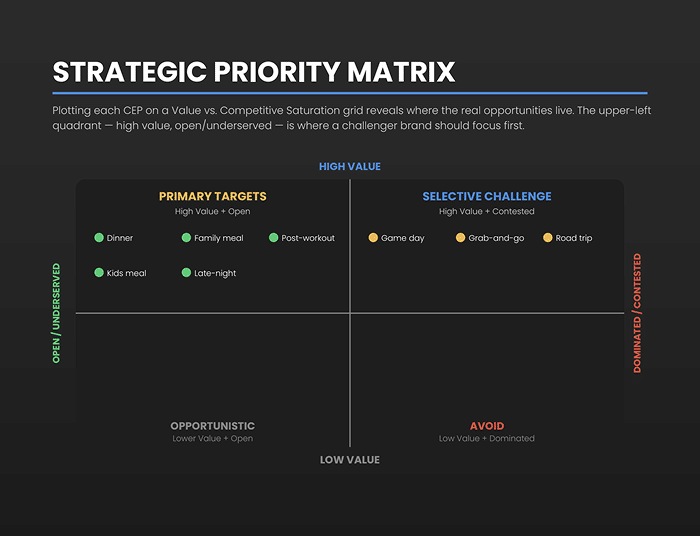
These agents pressure-test the work before it leaves the building. CEP Opportunity Scoring identifies and scores Category Entry Points against competitive whitespace. The Growth Code Devil’s Advocate challenges a plan’s assumptions against evidence-based effectiveness principles, flagging decisions that aren’t clear enough to survive the distance between strategy and execution.
3. Institutional agents
These tools protect what we’ve learned. The Brand Historian is a secure knowledge base containing past strategic work, raw research, transcripts, and brand guidelines. The strategy never starts from zero, and the institutional memory of a brand relationship doesn’t live exclusively in one person’s head.
4. Cognitive agents
These agents break fixed thinking. The Distillation & Framing agents reframe and rephrase — taking a strategy or a decision and running it through different perspectives. When you’ve been inside a particular project for any length of time, you develop a gravitational pull toward one worldview. They create the productive distance needed to see what familiarity and comfort may have hidden.
5. Visual agents
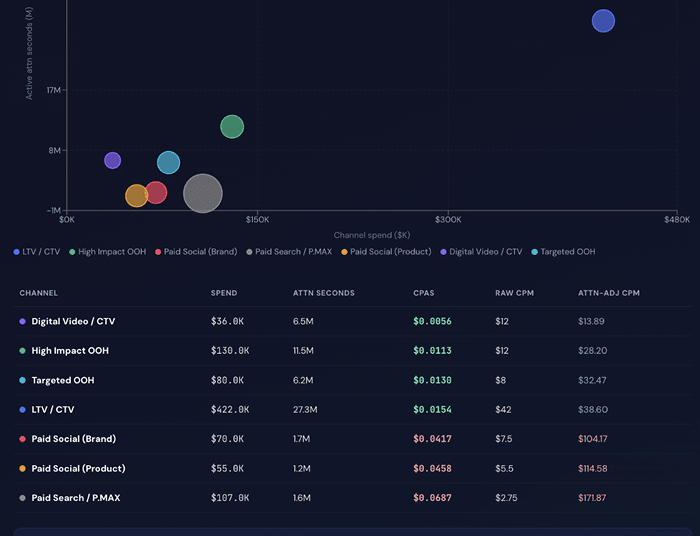
These agents make the math visible. They model campaign scenarios, budget allocations, and performance data across multiple lenses based on strategic inputs. They show both the sum and the parts without requiring a strategist to rebuild a chart every time an assumption changes.
What the agents don’t do
They don’t write the strategy. They don’t choose the creative territory. They don’t decide where or when a dollar should be invested.
They help strategists identify patterns that would otherwise take days to surface. But the pattern breaking — seeing where convention should be violated to earn disproportionate attention — stays with the humans directing the work.
The agents surface, test, remember, and reframe. But the decisions about when and where to pull them in, and most critically what to do with all of that — which bet to place, which memory to build, or which pattern to deliberately break — those belong to the strategist in the room.

Where does agentic strategy go from here?
This isn’t a finished system; it’s a working one. It will keep evolving as models improve and as we learn where agents genuinely help versus where they just feel productive. The line between heads-up and heads-down work will keep shifting, and we intend to keep shifting with it.
We continue to watch this practice with healthy skepticism. We ask ourselves: How does shifting pattern recognition to AI assistants change our team’s skills? Every project may differ, and time will tell.
But the principle shouldn’t change. The point was never to have the most AI. It is to have the most human judgment applied to the decisions that drive growth — and the best possible inputs when those decisions get made.
If you’re interested in seeing how our team elevates the heads-down work with heads-up creative thinking, give Mythic a shout at growth@mythic.us.