
You wouldn’t use a hammer to saw a board. You wouldn’t use a screwdriver to paint a wall. So why use a single AI video tool to do everything? The promise of a dominant, all-in-one platform is a tempting but ultimately unrealized dream today. The current reality of high-end AI video creation is far more nuanced and more collaborative, just like a more traditional production process.
The most effective AI video workflow relies not on a single, all-powerful tool, but on a strategic “tool-chaining” process. It’s about assembling a fellowship of specialized AI and post-production software. And in this fellowship, the human artist is the indispensable conductor, the taste-making expert in creative synthesis who knows precisely which tool to deploy for each step of the journey.
The human engine: AI is reshaping the work, not the creativity
Let’s be clear: AI is a revolutionary vehicle, but human vision is, and always will be, the engine. The landscape of AI tools is changing by the week, with new models and features emerging constantly. As an agency, we are committed to staying ahead of these trends, investing heavily in research and experimentation to understand which tools are best suited for which tasks and parts of the creative process.
What we’ve found is that AI is a powerful collaborator that reshapes how we make the work, but creativity, judgment, and storytelling remain fundamentally human endeavors. The true advantage of these tools is not in replacing traditional production, but in changing the creative calculus by making previously prohibitive ideas achievable. It’s a force multiplier for vision and possibility, leveling the playing field for brands of all sizes and budgets to produce video content beyond what they thought possible even a few years ago. AI particularly shines when it comes to rapid iteration whether that’s for testing and fine-tuning specific shots before ever stepping on set or generating multiple versions of a scene to select the best one for the edit.
Assembling the fellowship: a phased approach to your AI workflow
Success in this new landscape comes from understanding that each tool in your fellowship has a specific role to play in the modern AI video workflow. Trying to make one platform do everything is a recipe for frustration and mediocre results. Instead, we pull together different tools, both AI and traditional, breaking the journey into distinct phases with a champion for each.
Let’s take a look at how this fellowship approach worked for an AI video project we recently collaborated on with Cone Health, a large, not-for-profit healthcare system in North Carolina. Following a traditional full-up video production, our client John O’Connor, Director of Advertising & Brand, wondered what would be possible to create with AI. So we assembled our creative minds and AI tools and set out to produce a video for Cone Health that could go beyond the typical production constraints to bring our collective vision to life.
“I’ve been following AI trends for a while and have been curious to see where the technology might have a place in our broader marketing efforts. I approached the Mythic team with a test-and-learn opportunity: what could we make without the constraints of a typical production? From there, it was a highly collaborative process to bring our heart care story to life.” – John O’Connor, Director of Advertising & Brand at Cone Health
At the end of this article, we’ll reveal the final AI generated commercial that was produced using AI image, video, music, and voiceover tools. But let’s begin with the process.
Phase 1: Asset generation
This is where the raw material of your vision is born. Different tools excel at different things, and knowing their strengths is critical.
For the Cone Health video, we needed an emotional shot of an elderly woman holding a vintage locket. We started with a text-to-image prompt in Gemini and got a decent, if slightly “waxy,” result. So, we took that image to Midjourney, which is exceptional at creating photorealism and lighting. It returned a stunningly realistic portrait. But guess what? We lost our locket.
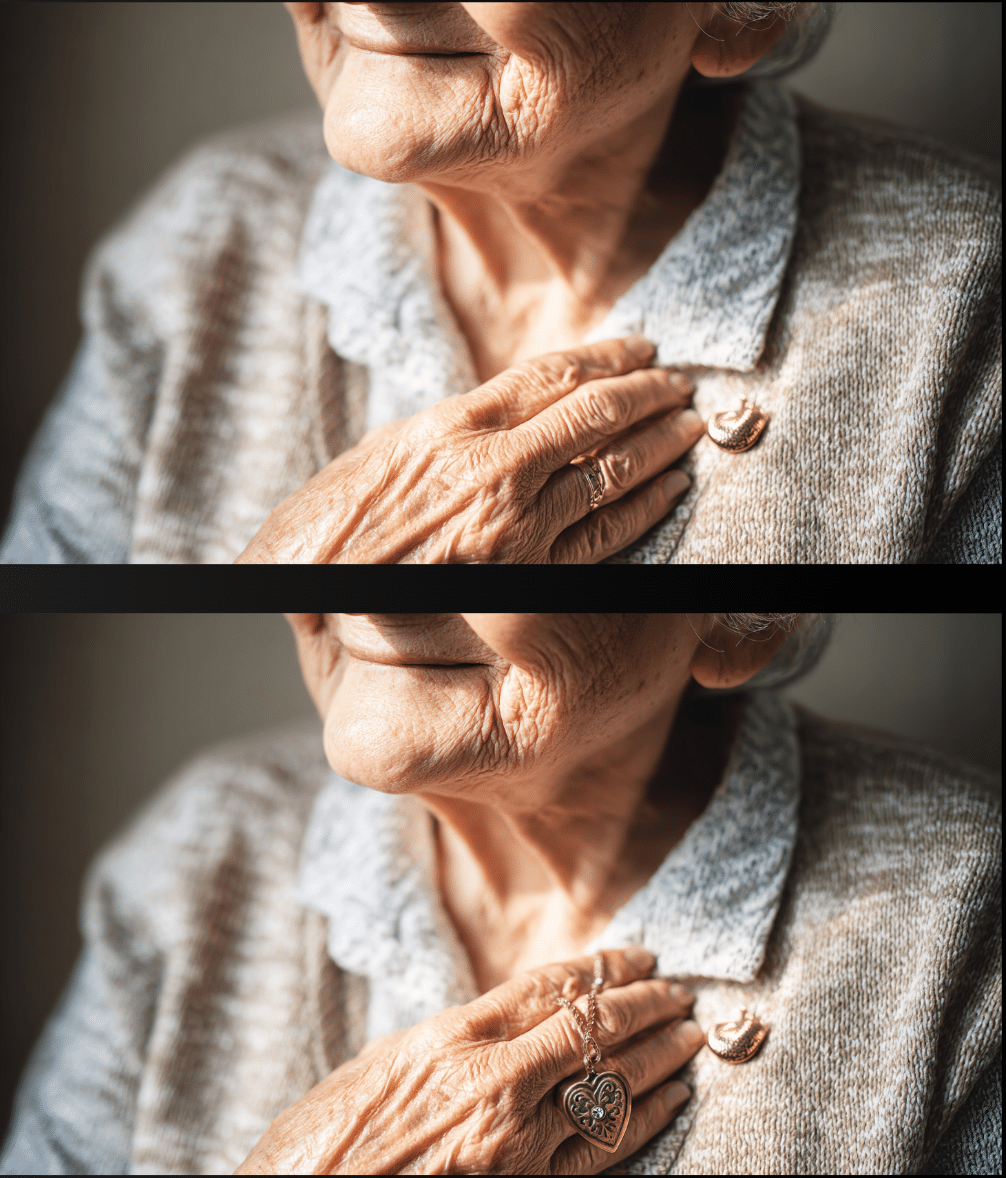
This is where the human artist steps in. Instead of wrestling with prompts, our art director brought the image into Adobe Photoshop, used Generative Fill to seamlessly add the locket back into the woman’s hand, and created the perfect still image. Only then did we take that final, human-refined image into video generation platform Runway to bring it to life with subtle motion.
This is tool-chaining in action. It’s not about finding one tool; it’s about using many (in this case Gemini, Midjourney, Photoshop, and Runway) in concert to achieve a specific creative goal.
Phase 2: Prompt optimization
This is a critical, often-overlooked step. A good prompt is the foundation of a good result, and using AI to enhance your prompts is a game-changer.
Each video platform interprets language differently. VEO responds best to long, descriptive, “cinematic” prompts filled with details about camera lenses, lighting, and composition. Runway, on the other hand, often prefers simpler, more direct language.
Using a large language model like ChatGPT or Gemini as a translator speeds up the process. You can describe your creative vision in plain English and then ask it to refine and enhance that idea, crafting prompt variations specifically tailored to the “dialect” of each AI video model you’re using. This single step will save hours of trial and error and get to a better result faster.
Phase 3: The 90% rule
Working with these tools requires a new mindset and a healthy respect for their current limitations. So we live by the rule that if an AI generation is 90% of what you need, export it and move on. Chasing that last 10% of perfection inside the AI tool often leads to diminishing returns or, worse, breaks what was already working.
We needed a shot of a proud father watching his daughter learning to ride a bike. One platform insisted on putting the dad on a unicycle. Another had him floating behind her. Finally, we got a version where he was standing still, but as he clapped, his arms morphed into something out of a bodybuilding competition. Was it perfect? No. But the core emotion was there — it was 90% right. We simply exported the clip, composited and scaled the shot in the edit to hide the bizarre arms, and moved on. It’s almost always faster to fix the final 10% with traditional editing than to re-roll the generative dice.

Phase 4: Refinement and compositing
The process doesn’t end with the AI generation. Due to AI generating short length clips, the most crucial step is bringing the assets into traditional software like Adobe Premiere and After Effects. This is where human artistry elevates the output to a polished piece of communication.
AI doesn’t make the final edit. AI doesn’t assemble the shots. It is the human artist who composites different elements, cleans up artifacts, performs color grading, mixes in sound design, and paces the edit. The final product is a hybrid — a testament to what happens when machine generation is guided by human craft.
The final output
This 30-second commercial for Cone Health generated by humans working with a fellowship of AI tools was released in December 2025.
AI isn’t replacing production, it’s extending it
The narrative that AI will replace creative professionals is presumptive. AI is a powerful new member of the creative toolkit, but it still needs visionaries who can mold, shape and craft the work. By empowering creators to visualize concepts faster, explore more options, and realize challenging scenes and visual effects, it is dramatically expanding what’s possible. Our creative approach now incorporates these tools not as a shortcut, but as a gateway to bringing bigger and bolder ideas to life.
The future of video production belongs not to the AI, but to the savvy creative who knows how to assemble a fellowship of tools and guide them with the timeless principles of craft, vision, and storytelling. Success will not be defined by who can make it the fastest or cheapest, but knowing when and how to use AI or when not to. And like with our Cone Health project, the key to success is ensuring that Agency and Client share the same vision.
If this strategic, tool-agnostic approach to video production resonates with your brand’s ambitions, reach out to newbiz@mythic.us.